
Learning Spanish isn’t just about grammar and vocabulary, it’s also about understanding how native speakers really communicate. One of the most fun parts of Spanish is its idioms, or expresiones idiomáticas.
These phrases don’t translate literally, but they are widely used in everyday conversation.
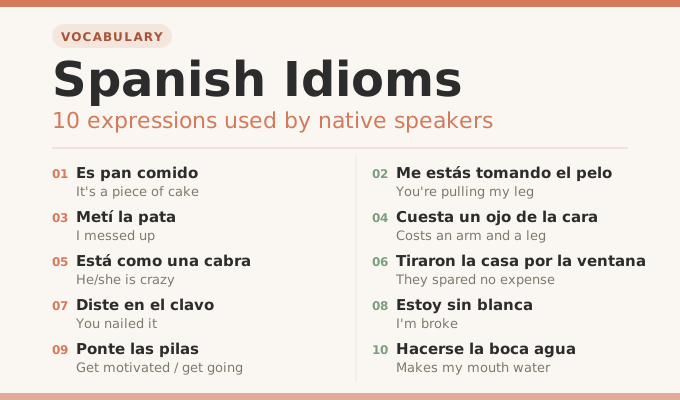
What Are Spanish Idioms?
Spanish idioms (called “expresiones idiomáticas”) are phrases where the meaning is different from the literal translation.
“Andarse con rodeos” literally means: go around in circle
But it actually means: to beat around the bush
Learning idioms helps you:
- Sound more natural in Spanish
- Understand native speakers better
- Improve your fluency faster
Check the list below to discover the most common idioms in Spanish.
1. Es pan comido (ser)
English meaning: It’s a piece of cake / very easy
El examen fue pan comido.
(The exam was a piece of cake.)
2. Me estás tomando el pelo (tomar)
English meaning: Are you pulling my leg? / joking with me
¿Me estás tomando el pelo?
(Are you pulling my leg?)
3. Metí la pata (meter)
English meaning: I messed up / made a mistake
Metí la pata en la reunión.
(I messed up in the meeting.)
4. Cuesta un ojo de la cara (costar)
English meaning: It costs an arm and a leg / very expensive
Ese coche cuesta un ojo de la cara.
(That car costs an arm and a leg.)
5. Está como una cabra (estar)
English meaning: He/she is crazy / nutty
Ese chico está como una cabra.
(That guy is crazy.)
6. Tiraron la casa por la ventana (tirar)
English meaning: They spared no expense / went all out
Tiraron la casa por la ventana en la boda.
(They spared no expense at the wedding.)
7. Diste en el clavo (dar)
English meaning: You hit the nail on the head
Diste en el clavo con tu respuesta.
(You nailed it with your answer.)
8. Estoy sin blanca (estar)
English meaning: I’m broke / have no money
No puedo salir, estoy sin blanca.
(I can’t go out, I’m broke.)
9. Ponte las pilas (ponerse)
English meaning: Get your act together / get motivated
Tienes que ponerte las pilas con el estudio.
(You need to get motivated about studying.)
10. Hacerse la boca agua (hacerse)
English meaning: To make your mouth water / look delicious
Ese pastel me hace la boca agua.
(That cake makes my mouth water.)
Tips to Learn Spanish Idioms Faster
Learn idioms in context, not as isolated phrases.
Study them in complete sentences and real-life examples. This helps you understand how native speakers use these expressions in conversation.
For example:
- Metí la pata en la reunión.
(I messed up in the meeting.) - Juan siempre está en las nubes en clase.
(Juan is always daydreaming in class.)
Practice using them in sentences
Try writing short sentences, dialogues, or even mini-stories using new expressions.
For example, you can create sentences like:
- No hay tutía, tendremos que cancelar el viaje.
(There’s no way; we’ll have to cancel the trip.) - Tiraron la casa por la ventana en la fiesta de cumpleaños.
(They spared no expense at the birthday party.)
Watch Spanish TV shows or videos
Shows, movies, and YouTube videos are packed with common expressions and everyday phrases that textbooks rarely teach.
Tips for watching Spanish content:
- Turn on subtitles in Spanish to catch idioms in context.
- Pause and note down new expressions.
- Repeat phrases aloud to practice pronunciation and intonation.
Keep a personal idiom notebook
Maintaining a personal notebook or digital list of idioms is one of the most effective ways to track your progress. For each idiom, include:
- The Spanish phrase and infinitive verb
- English meaning or closest equivalent
- Example sentence
- Notes about situations where it’s commonly used
For example:
- Ponte las pilas con el estudio.
(Get your act together with your studying.) - Diste en el clavo con tu respuesta.
(You hit the nail on the head with your answer.)
Review your notebook regularly and try using idioms in daily conversations.
Leave a Reply