
Spanish has two verbs that mean “to know”: saber and conocer. Saber is used for facts, information and skills, and conocer for people, places and things you know from experience.
For example, Sé dónde está Bilbao means “I know where Bilbao is”, while Conozco Bilbao means “I know Bilbao”, because you have been there.
Since English uses the same verb in both cases, it is common to mix them up at first. Once the difference is clear, though, choosing between them becomes much easier.
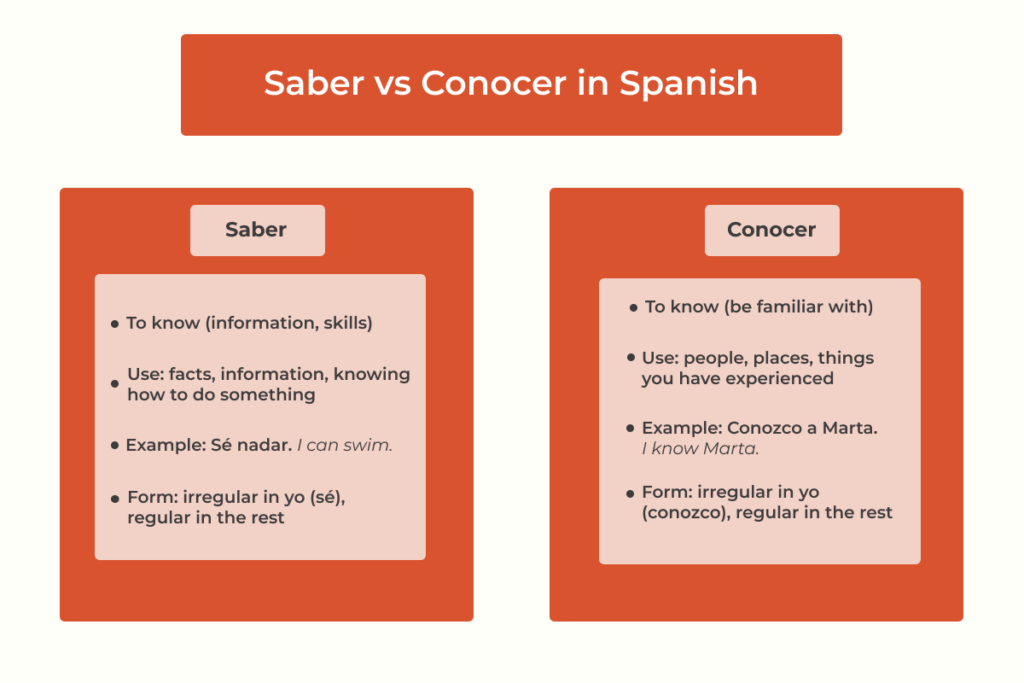
When to use saber
Saber is used for anything you could learn, look up or write down.
It is the verb for facts and pieces of information: Sé su número de teléfono (I know his phone number), or ¿Sabes a qué hora abre el museo? (Do you know what time the museum opens?).
It is also used before que, to say that you know something is true: Sé que estás ocupado (I know you’re busy). And before question words such as dónde, cuándo, cómo, qué or por qué: No sé dónde he dejado las llaves (I don’t know where I’ve left my keys).
Saber is also how Spanish talks about skills. Where English says “I can swim” or “I know how to swim”, Spanish simply uses saber followed by the infinitive: Sé nadar. ¿Sabes conducir? (Can you drive?) Mi hermana sabe tocar la guitarra (My sister can play the guitar).
If you can put “that”, “how to”, “where”, “when” or “why” after “know” in English, the Spanish verb is almost always saber.
When to use conocer
Conocer is used for things you know from your own experience: people you have met, places you have been to and things you are familiar with.
With people, it always goes with a: Conozco a tu hermano (I know your brother). This a is known as the personal a, and Spanish adds it whenever the object of the verb is a specific person.
With places, conocer means you have been there: ¿Conoces Sevilla? (Do you know Seville? / Have you been to Seville?). In Spain this is the usual way to ask if someone has visited a place.
It also works for books, films, songs, restaurants and anything else you are familiar with: ¿Conoces este libro? (Do you know this book?) Conozco un bar muy bueno cerca de aquí (I know a really good bar near here).
Conocer is also the verb for meeting someone for the first time, as in Encantado de conocerte (Nice to meet you) or ¿Dónde os conocisteis? (Where did you two meet?).
In English, “to be familiar with” is usually a good test. If it fits the sentence, conocer is the verb you need.
How to conjugate saber and conocer
In the present tense, both verbs are irregular only in the yo form. The other forms are regular.
| saber | conocer | |
|---|---|---|
| yo | sé | conozco |
| tú | sabes | conoces |
| él / ella / usted | sabe | conoce |
| nosotros | sabemos | conocemos |
| vosotros | sabéis | conocéis |
| ellos / ellas / ustedes | saben | conocen |
The accent on sé is important, because se without an accent is a pronoun, as in se llama Ana (her name is Ana).
The z in conozco also appears in other verbs ending in -cer and -cir, such as parezco (parecer), conduzco (conducir) and traduzco (traducir). More forms like these are on the present tense page.
Saber and conocer in the past
In the past tenses, the meaning of both verbs changes slightly. The imperfect describes something that was already known, and the preterite marks the moment it became known.
| Verb | Imperfect | Preterite |
|---|---|---|
| saber | Sabía que vivías aquí. I knew you lived here. | Supe que vivías aquí. I found out you lived here. |
| conocer | Conocía a Luis. I knew Luis. | Conocí a Luis en una boda. I met Luis at a wedding. |
That is why conocí translates as “I met” and supe usually translates as “I found out”: Cuando supe la noticia, llamé a mi madre (When I heard the news, I called my mum).
Saber is irregular in the preterite (supe, supiste, supo, supimos, supisteis, supieron), while conocer is regular (conocí, conociste, conoció…). The preterite vs imperfect guide and the past tense page explain these tenses in more detail.
Sentences that can use both verbs
Some sentences work with either verb, but the meaning is not the same.
With a city or a country, saber is about information and conocer is about having been there. ¿Sabes dónde está Cádiz? asks if someone knows where Cádiz is, while ¿Conoces Cádiz? asks if they have been there.
With people, saber is used for facts about someone and conocer for knowing the person. Sé cómo se llama, pero no lo conozco means “I know his name, but I don’t know him”.
With songs and poems, conocer means you are familiar with them and saber means you know the words. Conozco esa canción is “I’ve heard that song before”, but Me sé esa canción is “I know that song by heart”. When you know something by heart, Spanish often adds a pronoun like this (me sé, te sabes, se sabe): Se sabe todas las capitales de Europa (He knows all the capitals in Europe).
With languages and subjects, saber is the usual choice: Sabe inglés y francés (She knows English and French), Sabe mucho de historia (She knows a lot about history). For languages, habla inglés is even more common.
Common mistakes (and how to avoid them)
Using saber with people. Spanish doesn’t use saber for knowing a person, so instead of sé a María, the correct form is conozco a María. Saber only works for facts about her: sé dónde trabaja María (I know where María works).
Using conocer for skills. Knowing how to do something is always saber, so it is sé cocinar, not conozco cocinar.
Forgetting the personal a. With people, conocer needs an a: conozco a Marta, not conozco Marta. With places there is no a: conozco Valencia.
Translating “how to” word for word. Sé cómo nadar will be understood, but it sounds unnatural. In Spanish it is just sé nadar.
Using poder instead of saber. Both can translate as “can”, but they are not the same. ¿Sabes nadar? asks if someone has learnt to swim, while ¿Puedes nadar? asks if they are able to at that moment, for example after an injury or if swimming is allowed.
Making the yo form regular. Forms like yo sabo or yo conoco are a very common slip. The correct forms are sé and conozco.
Everyday expressions with saber and conocer
Both verbs appear in many expressions you will hear in everyday conversation in Spain.
| Spanish | English |
|---|---|
| No sé | I don’t know |
| ¿Sabes qué? | You know what? |
| Yo qué sé | Who knows / How should I know? |
| Que yo sepa | As far as I know |
| Saber a | To taste of (Esta sopa sabe a ajo: This soup tastes of garlic) |
| Un sabelotodo / una sabelotodo | A know-it-all |
| Encantado / Encantada de conocerte | Nice to meet you |
| Conocer algo como la palma de la mano | To know something like the back of your hand |
Yo qué sé is very common, but it is quite casual and can sound a bit abrupt depending on the tone, so it is best kept for friends and family.
Quick reference: saber or conocer?
| Use saber for | Use conocer for |
|---|---|
| Facts and information: Sé su nombre. | People: Conozco a Ana. |
| Skills: Sé nadar. | Places you have been to: Conozco Madrid. |
| Sentences with que: Sé que estás cansado. | Books, films or songs you are familiar with: Conozco esa canción. |
| Question words: Sé dónde está. | Meeting someone: Encantado de conocerte. |
| “I found out” in the preterite: Supe la verdad. | “I met” in the preterite: Conocí a Luis. |
When in doubt, ask yourself: is this information I could learn or look up, or something I know from experience? The first one goes with saber, the second one with conocer.
Practise it
Try to translate these sentences into Spanish before looking at the answers. Focus on choosing the right verb rather than getting every word perfect.
- I know your sister.
- Do you know where the station is?
- I can’t swim.
- Have you been to Barcelona?
- We met in Madrid.
- I know she’s tired.
- Do you know any good restaurants around here?
- When I found out, I called you.
Answers:
- Conozco a tu hermana. A person, so conocer, with the personal a.
- ¿Sabes dónde está la estación? Information with a question word.
- No sé nadar. A skill, so saber + infinitive.
- ¿Conoces Barcelona? Asking about experience of a place.
- Nos conocimos en Madrid. The moment you met, in the preterite.
- Sé que está cansada. Saber + que.
- ¿Conoces algún restaurante bueno por aquí? Being familiar with places.
- Cuando lo supe, te llamé. Supe means “I found out”.
If you got most of them right, you are on the right track. A useful exercise is to write five sentences about yourself, some with things you know how to do and some with people and places you know, and check which verb each one needs.
If you want to keep going, the ser and estar guide covers another pair of verbs that English speakers often confuse, and the preterite vs imperfect guide explains the past tenses used in this post in more detail.
Leave a Reply