
Por and para are two of the most confusing words for anyone learning Spanish, and it’s easy to see why. In English, “for” covers a huge range of meanings, and Spanish splits all of that into two different words.
Para is about where something is going, its purpose, or a point in time. Por is about why something happens, or a cause behind it.
That’s the short version, and if you only remember one thing from this post, remember that. But there are enough real-life cases (and a few phrases that don’t play by the rules) that it’s worth going through properly.
Why English Speakers Find This Difficult
The root of the confusion is simple: English uses one word, “for,” to cover situations that Spanish treats as completely separate ideas. “I bought this for you,” “I’m leaving for Valencia,” and “thanks for your help” all use “for” in English, but in Spanish those three sentences use para, para, and por. There’s no single translation trick that works every time, since the choice depends on the underlying meaning of the sentence rather than the English word itself. That’s exactly why so many learners end up guessing, and why it’s worth learning the logic behind each word rather than trying to memorise a list of translations.
When to use para
Think of para as pointing forward, towards a goal, a person, a place, or a deadline.
Purpose: what something is used for, or why you’re doing something.
Uso esta app para practicar español. I use this app to practice Spanish.
Who it’s for: the person receiving something.
Este regalo es para ti. This gift is for you.
Where you’re headed: an actual destination.
Salgo para Valencia mañana. I’m leaving for Valencia tomorrow.
A deadline: by when something has to be done.
Necesito esto para el viernes. I need this by Friday.
Giving your opinion: “para mí” works like “for me” in the sense of “in my opinion.”
Para mí, el español es más fácil que el francés. For me, Spanish is easier than French.
A quick trick: if you could replace “for” with “in order to” or “by (a certain time)” in the English sentence, you’re almost always looking at para.
When to use por
Por looks backwards, at the reason, cause, or general area around something, rather than a fixed destination.
Cause or reason: why something happened.
Llegué tarde por el tráfico. I was late because of the traffic.
A length of time: how long something lasted.
Viví en Barcelona por tres años. I lived in Barcelona for three years.
Exchanging one thing for another: including prices.
Pagué veinte euros por el libro. I paid twenty euros for the book.
Moving through a place: not towards a specific point, just around or across it.
Caminé por el centro toda la tarde. I walked around the centre all afternoon.
Doing something on someone’s behalf:
Firmé el documento por mi hermana. I signed the document for my sister (in her place).
By means of something:
Te llamo por teléfono. I’ll call you by phone.
If the sentence answers a “why” question, or explains a cause, it’s almost always por.
The phrases that don’t follow either rule
Spanish has a handful of set expressions with por and para that native speakers use automatically, without applying any logic at all. It’s honestly easier to just learn these as fixed phrases rather than try to reason your way through them:
Por favor (please), por ejemplo (for example), por supuesto (of course), por fin (finally), por lo general (generally), para nada (not at all), para siempre (forever).
A common mistake: learners try to apply the purpose/cause logic to these phrases and end up overthinking a simple expression. If a phrase feels fixed, it probably is, so just learn it the way you’d learn any other vocabulary.
Por vs Para Quick Reference
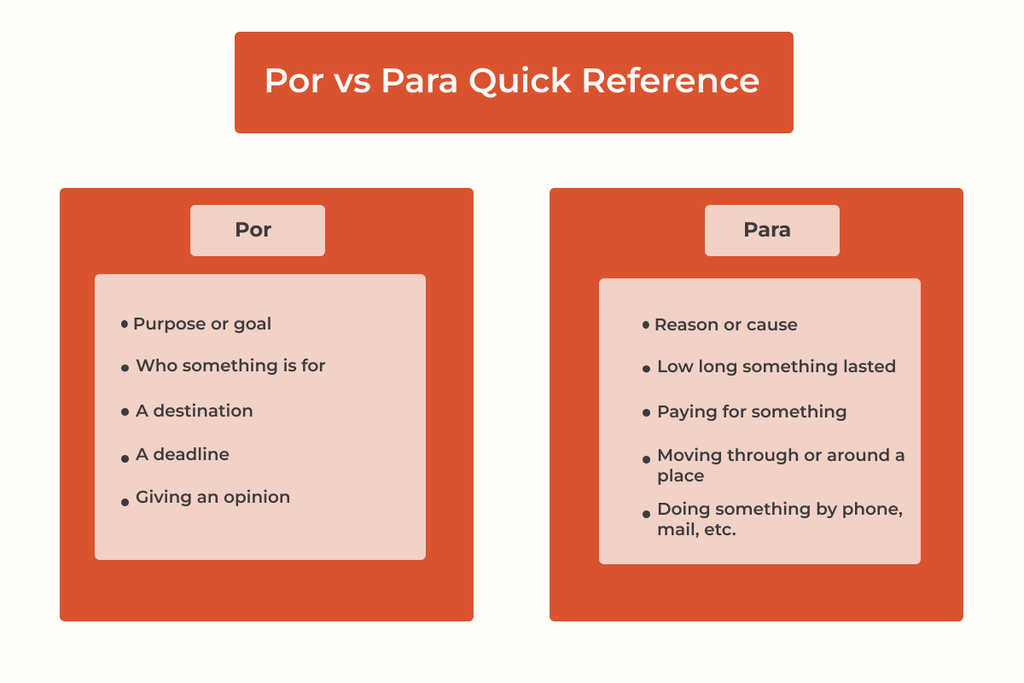
Por vs Para with Examples
Try translating these into Spanish, then check yourself against everything above:
- I need the report by Monday.
- I lived in Madrid for two years.
- Thanks for your help.
- I’m leaving for Barcelona on Sunday.
- I paid fifteen euros for this book.
- We walked around the old town all morning.
- This coffee is for you.
If you can get most of those right, you’ve got the difference down. The rest just comes with practice and hearing it used in context.
For a similar pair that confuses learners for the same reason, English uses one verb where Spanish uses two, so take a look at the ser and estar guide next.
Leave a Reply