
What Are Irregular Verbs in Spanish?
In Spanish, irregular verbs are verbs that don’t follow the regular conjugation patterns.
That means their endings or stems change when you conjugate them.
They’re very common in daily conversations, so learning them early will make your Spanish sound much more natural.
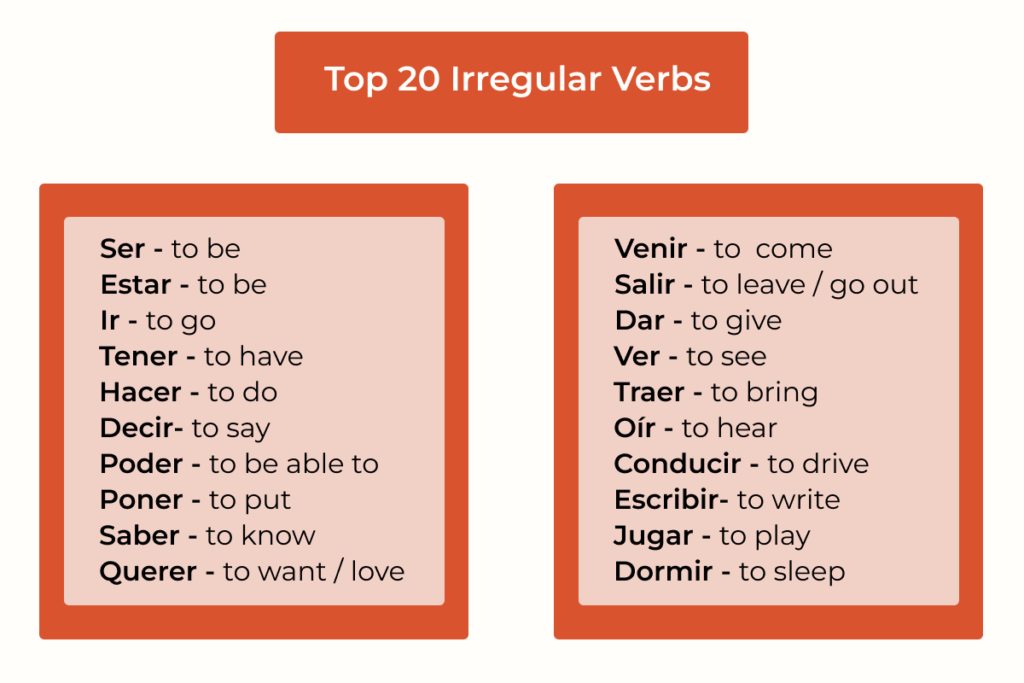
Here are the 20 most important irregular verbs you’ll hear and use all the time.
List of most important Irregular Verbs
1. Ser – to be (permanent)
- Yo soy estudiante. I am a student.
Used for descriptions, identity, origin, and time.
2. Estar – to be (temporary/location)
- Estoy en casa. I’m at home.
Used for location, temporary states, and emotions.
3. Ir – to go
- Voy al trabajo. I go to work.
Irregular in almost every form.
4. Tener – to have
- Tengo un coche. I have a car.
Used for possession and many expressions: tener hambre, tener frío…
5. Hacer – to do / make
- Hago ejercicio cada día. I exercise every day.
6. Decir – to say / tell
- Digo la verdad. I tell the truth.
7. Poder – to be able to / can
- Puedo ayudarte. I can help you.
8. Poner – to put / place
- Pongo la mesa. I set the table.
9. Saber – to know (facts, information)
- Sé la respuesta. I know the answer.
10. Querer – to want / love
- Quiero aprender español. I want to learn Spanish.
11. Venir – to come
- Vengo de España. I come from Spain.
12. Salir – to leave / go out
- Salgo con mis amigos. I go out with my friends.
13. Dar – to give
- Doy regalos en Navidad. I give gifts at Christmas.
14. Ver – to see
- Veo una película. I watch a movie.
15. Traer – to bring
- Traigo comida. I bring food.
16. Oír – to hear
- Oigo música. I hear music.
17. Conducir – to drive
- Conduzco al trabajo. I drive to work.
18. Traducir – to translate
- Traduzco del inglés al español. I translate from English to Spanish.
19. Jugar – to play (a sport or game)
- Juego al fútbol. I play soccer.
20. Dormir – to sleep
- Duermo ocho horas. I sleep eight hours.
Tips for Learning Irregular Verbs
Learning irregular verbs can feel challenging at first, but there are easy ways to make it more natural and effective.
Here are some simple methods to help you remember and use them in real conversations.
1. Group Similar Verbs Together
Many irregular verbs share similar patterns.
When you study them in groups, your brain recognizes the connection and memorizes them faster.
For example:
- Conducir, traducir, producir → all change to -zco in the first person:
- Conduzco al trabajo. (I drive to work.)
- Traduzco textos del inglés. (I translate texts from English.)
- Produzco música. (I produce music.)
Other groups you can study together:
- Tener, venir → both add -g in the first person: tengo, vengo.
- Poder, dormir, volver → change o → ue: puedo, duermo, vuelvo.
- Querer, entender, pensar → change e → ie: quiero, entiendo, pienso.
Grouping verbs makes patterns easier to spot and remember.
2. Focus on the Present Tense First
The present tense is used the most in daily conversations, so mastering it gives you a big advantage.
You’ll use it to describe what you do, what you like, and how you feel.
For example:
- Tengo hambre. (I’m hungry.)
- Voy al trabajo. (I’m going to work.)
- Hago ejercicio cada mañana. (I do exercise every morning.)
- Estoy feliz hoy. (I’m happy today.)
Once you’re comfortable with the present tense, it becomes much easier to learn other tenses (like past or future) later.
3. Practice with Real-Life Examples
The best way to remember verbs is to use them in sentences that connect to your daily life.
Instead of memorizing long lists, try to make examples about yourself, your routines, or your interests.
For instance:
- Quiero café. I want coffee.
- Puedo ir contigo. I can go with you.
- Salgo a caminar por la tarde. I go out for a walk in the afternoon.
- Duermo ocho horas cada noche. I sleep eight hours every night.
- Voy al parque por las mañana. I go to the park in the morning.
You can even turn this into a small exercise:
Write 5 sentences each day using any irregular verbs you’re learning.
After one week, you’ll naturally start remembering the forms.
4. Listen and Repeat
Hearing the verbs in context helps you internalize their rhythm and pronunciation.
You can:
- Watch short videos or listen to songs that include these verbs.
- Repeat the sentences aloud. For example:
- Voy al cine. (I go to the cinema.)
- Tengo que estudiar. (I have to study.)
- Quiero descansar. (I want to rest.)
Repetition through listening makes irregular verbs sound ‘normal’ to your ears.
5. Use Flashcards or Mini Quizzes
Digital tools like Quizlet, Anki, or simple paper flashcards are great for review.
Write the verb on one side and the translation with examples on the other:
Front: Tener
Back: to have. Example: Tengo un gato. (I have a cat.)
Visit our Irregular Verbs page for more content on this topic.