
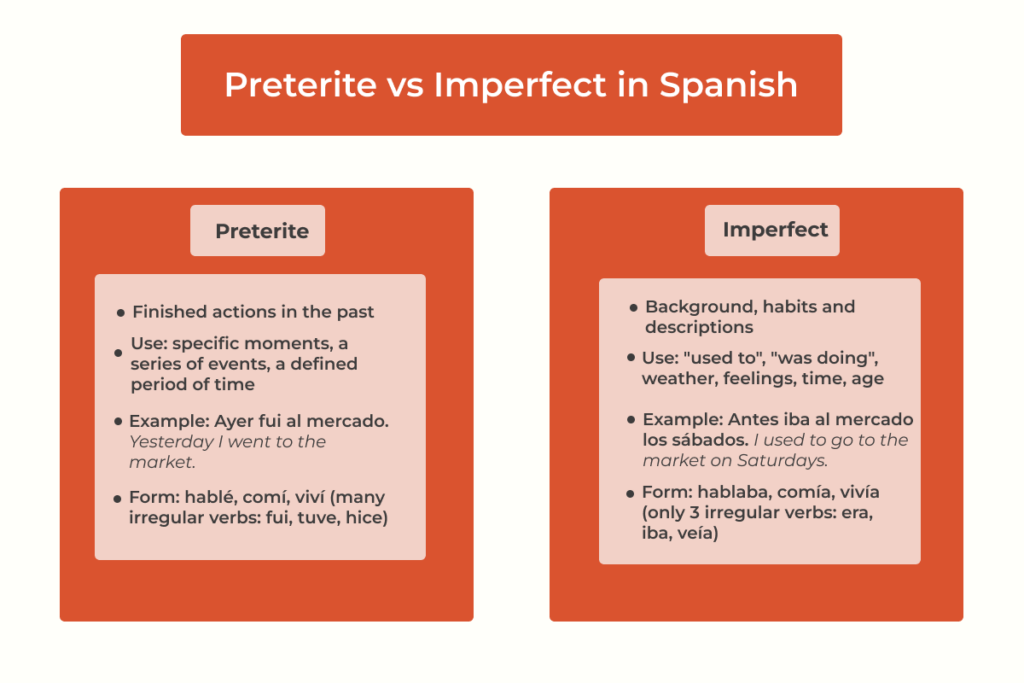
Use the preterite for actions that are finished and happened at a specific moment: Ayer comí paella (Yesterday I ate paella). Use the imperfect for the background of a story: descriptions, habits, and things that were in progress: Cuando era pequeña, comía paella todos los domingos (When I was little, I used to eat paella every Sunday).
That’s the short answer. In practice, though, this is one of the topics that confuses learners the most, and it’s not because the rules are hard. English uses one past tense for both situations, so your brain has never needed to make this choice before. “I ate” can be a single event or a habit, and English doesn’t care. Spanish does.
When to use the preterite
The preterite (pretérito indefinido) is the tense for completed actions. If you can picture the action with a clear start and a clear end, the preterite is usually the right choice.
Actions that happened at a specific time
- Ayer llamé a mi madre. (Yesterday I called my mum.)
- El año pasado visitamos Granada. (Last year we visited Granada.)
- La película empezó a las nueve. (The film started at nine.)
A series of actions, one after another
When you’re telling someone what you did, step by step, each step is a finished action:
- Me levanté, me duché y salí de casa. (I got up, had a shower and left the house.)
Actions with a defined length of time
This one surprises many learners. Even if something lasted a long time, if you say exactly how long and it’s over, you use the preterite:
- Viví en Valencia dos años. (I lived in Valencia for two years.)
- Estuvimos en la playa toda la tarde. (We were at the beach all afternoon.)
How to form it
| Hablar | Comer | Vivir | |
|---|---|---|---|
| yo | hablé | comí | viví |
| tú | hablaste | comiste | viviste |
| él / ella / usted | habló | comió | vivió |
| nosotros | hablamos | comimos | vivimos |
| vosotros | hablasteis | comisteis | vivisteis |
| ellos / ustedes | hablaron | comieron | vivieron |
Many of the most common verbs are irregular in the preterite, such as ser and ir (both fui, fuiste, fue…), tener (tuve), hacer (hice) and estar (estuve). You’ll find them in my Past tense conjugation page and in Top 20 Irregular Spanish Verbs.
When to use the imperfect
The imperfect (pretérito imperfecto) is for things that were going on, things that used to happen, and descriptions. The focus isn’t on when the action started or finished.
Habits and repeated actions in the past
If you could say “used to” or “would” in English, it’s almost always the imperfect:
- Cuando era pequeña, pasaba los veranos en el pueblo de mis abuelos. (When I was little, I used to spend the summers in my grandparents’ village.)
- Mi padre nos llevaba al parque los domingos. (My dad would take us to the park on Sundays.)
Descriptions of people, places, weather and feelings
- La casa era vieja pero tenía un jardín precioso. (The house was old but it had a beautiful garden.)
- Hacía sol y la playa estaba llena de gente. (It was sunny and the beach was full of people.)
- Estaba muy cansado. (He was very tired.)
Time and age
Telling the time and saying how old someone was always use the imperfect:
- Eran las ocho de la mañana. (It was eight in the morning.)
- Tenía diez años cuando aprendí a nadar. (I was ten when I learnt to swim.)
Actions in progress
When English uses “was doing”, Spanish often uses the imperfect:
- Yo leía mientras mi hermano veía la tele. (I was reading while my brother was watching TV.)
How to form it
Good news: the imperfect is one of the easiest tenses in Spanish.
| hablar | comer | vivir | |
|---|---|---|---|
| yo | hablaba | comía | vivía |
| tú | hablabas | comías | vivías |
| él / ella / usted | hablaba | comía | vivía |
| nosotros | hablábamos | comíamos | vivíamos |
| vosotros | hablabais | comíais | vivíais |
| ellos / ustedes | hablaban | comían | vivían |
Only three verbs are irregular in the imperfect: ser (era), ir (iba) and ver (veía). That’s it.
Using both tenses in the same sentence
This is where the two tenses really make sense. Very often, something was happening (imperfect) when something else interrupted it (preterite):
- Estaba en la ducha cuando sonó el teléfono. (I was in the shower when the phone rang.)
- Caminábamos por el centro cuando empezó a llover. (We were walking through the centre when it started to rain.)
- Mientras cenábamos, se fue la luz. (While we were having dinner, the power went out.)
Now look at a short story, the kind of thing you might tell a friend:
Era sábado y hacía mucho calor. Mis amigos y yo estábamos en una terraza de la Plaza Mayor y tomábamos algo tranquilamente. De repente, empezó a llover y todos corrimos dentro del bar.
(It was Saturday and it was really hot. My friends and I were on a terrace in the Plaza Mayor having a drink. Suddenly, it started to rain and we all ran inside the bar.)
Era, hacía, estábamos and tomábamos set the scene. Nothing has happened yet. Then empezó and corrimos arrive, and the story moves. If you remember the theatre picture, the imperfect is the stage and the preterite is what the actors do on it.
Time expressions that help you choose
Some words and phrases point strongly towards one tense or the other. They’re useful clues when you’re not sure.
| Usually preterite | Usually imperfect |
|---|---|
| ayer (yesterday) | siempre (always) |
| anoche (last night) | todos los días (every day) |
| la semana pasada (last week) | normalmente (normally) |
| el año pasado (last year) | a menudo (often) |
| hace dos días (two days ago) | cuando era pequeño/a (when I was little) |
| en 2019 (in 2019) | mientras (while) |
| de repente (suddenly) | antes (before, in the past) |
| una vez (once) | de niño/a (as a child) |
Be careful, though: these are clues, not rules. Ayer estaba cansada (Yesterday I was tired) is perfectly correct, because it describes how I felt, not an event. Always ask yourself what you’re doing in the sentence: telling what happened, or describing how things were.
Verbs that change meaning
A few common verbs mean something slightly different depending on which past tense you use. Once you know these, a lot of sentences that seemed strange suddenly make sense.
| Verb | Imperfect | Preterite |
|---|---|---|
| saber | sabía = I knew | supe = I found out |
| conocer | conocía = I knew (someone or a place) | conocí = I met (for the first time) |
| querer | quería = I wanted | quise = I tried; no quise = I refused |
| poder | podía = I could, I was able to | pude = I managed to; no pude = I couldn’t (and didn’t) |
Some examples:
- Supe la noticia por la radio. (I found out the news on the radio.)
- Conocí a mi mejor amiga en la universidad. (I met my best friend at university.)
- No pude dormir en toda la noche. (I couldn’t sleep all night.)
Saber and conocer are tricky in other ways too, so they’ll get their own post soon.
Common mistakes English speakers make
1. Using the preterite for every “-ed” verb in English
English simple past can describe habits, but Spanish needs the imperfect for those. “Every summer we went to the beach” is Todos los veranos íbamos a la playa, not fuimos.
2. Thinking a long time means imperfect
Length doesn’t decide the tense. If the period has a clear limit and it’s over, use the preterite: Trabajé en un hotel cinco años (I worked in a hotel for five years).
3. Using the preterite for age
Tuve veinte años sounds wrong to a native speaker. Say Tenía veinte años (I was twenty). If you want to say you turned twenty, use cumplir: Cumplí veinte años en Madrid (I turned twenty in Madrid).
4. Relying only on trigger words
Words like ayer or siempre help, but they don’t decide for you. Think about what the sentence is doing before you choose.
5. Getting confused by how people talk in Spain
Here’s something textbooks don’t always tell you. In Spain, we usually use a third tense, the present perfect (he comido, has visto), for things that happened today or recently. So in Madrid you’ll hear Esta mañana he desayunado tostadas (This morning I had toast), while in Mexico or Argentina people would say desayuné. Don’t worry if you hear this: it doesn’t change anything about the preterite and imperfect, it’s just a regional preference.
Quick reference
| Preterite | Imperfect | |
|---|---|---|
| Main idea | Finished actions, events | Background, habits, descriptions |
| English clue | “I did” | “I used to do”, “I was doing” |
| Typical uses | Specific moments, sequences, defined periods | Habits, weather, feelings, time, age, actions in progress |
| In a story | What happened | How things were |
| Example | Ayer fui al mercado. | Antes iba al mercado todos los sábados. |
| Irregular verbs | Many (fui, tuve, hice, estuve…) | Only three (era, iba, veía) |
Practice: preterite or imperfect?
Fill in the gaps with the correct form of the verb in brackets. Try to explain to yourself why you chose each tense before checking the answers.
- Ayer ___ (ir, yo) al cine con Marta.
- Cuando ___ (ser, yo) pequeño, ___ (vivir, yo) en un pueblo.
- ___ (hacer) frío y ___ (llover) sin parar.
- Mientras ___ (cocinar, yo), mi hermano ___ (llegar) a casa.
- El verano pasado ___ (visitar, nosotros) Sevilla.
- Mi abuela siempre nos ___ (contar) historias antes de dormir.
- ___ (conocer, yo) a Javier en una fiesta en 2020.
- ___ (ser) las once cuando ___ (terminar) la película.
Answers
- fui: a single, finished action yesterday.
- era, vivía: age and a situation in the past.
- Hacía, llovía: describing the weather.
- cocinaba, llegó: an action in progress interrupted by another one.
- visitamos: a finished event at a specific time.
- contaba: a repeated habit.
- Conocí: meeting someone for the first time.
- Eran, terminó: the time is background, the film ending is the event.
If you got most of them right, you’re on the right track. The best way to make this feel natural is to practise telling your own stories out loud. Try describing what you did last weekend, then what you used to do as a child.
Leave a Reply